Jack Jezreel 2
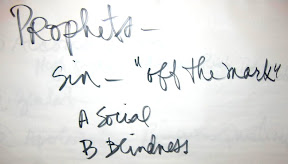
It's a pleasure to talk to people who know the scriptures. I've had experience working with wealthy communities and poor communities. I was raised in a wealthy family. I was briefly a professional tennis player. Then I spend 6 years living with mentally ill adults. Over time my clothing began to look like theirs. Once I was mistaken for the mentally disabled folks that I worked with. I traveled and worked with poor peoples around the world. I try to interpret the gospel through both contexts. Those experiences have inclined me to hear when Jesus is speaking to a privileged constituency and other times when he speaks to a marginalized constituency. I'm assuming that all of you are working with privileged constituency. Rich and Poor. Poor means that you worry about what you will eat today. I'm assuming that members of your church are not at-risk. Most of us here are not pastors at a church but rather work in the community. Today I will not move as quickly but address questions as we go along. Yesterday I did not speak about ancient history. The Bible is a living truth that is insightful for the human reality that is relevant for today. Yesterday's description of Egypt is a hermeneutic for identifying one form of evil. We presume that evil is readily recognized. The biblical testimony is that evil is much more clever than that. This makes communal discernment all the more important. For example, suddenly you wake up and realize that you are secure in benefits. Plenty of money, plenty of food, lots of extras. You find that you must make deals with those who are powerful to continue these benefits. When we hear pastors critique these things we get offended at this threat to our benefits. We begin to look for another church. We face the same tests as Jesus to wealth, power and prestige and religious authority This morning I read this: We seek wealth, we seek prestige, we seek power. The gospel tells us to seek poverty, seek prestige, seek humility. The scriptures are the truthful lens to determine what is good and not good. What's worth living for and what's worth dying for. What is God looking for the world to become? Prophets: The archeological evidence shows us that the covenant is lived out well for 250 years. The evidence shows us little houses on 10 acres or so. We have the appearance of a village with even distribution. There is no evidence of profits. After this period Israel found itself in a very profitable trade route. Israel started to get rich. We begin to see big houses with big property and tenant farmers. This is when the prophets rise up. The prophets speak on behalf of those at the margins. Prophets sometimes tell the future. But they usually tell the present. They are spokesman for God about the consequences of the present. The consequences of injustice are violence, division and upheaval. Prophets speak of sin. The Hebrew word for sin comes from archery meaning "off the mark". The prophetic understanding of sin has two flavors: Individual acts that are wrong: also "social" sin that is bigger than the individual acts. As a child we learned venial and mortal sin as categories. Mortal sin was serious, with reflection and full consent. The prophetic understanding of sin is what "somebodies" do. "My people" are in sin. Unlike mortal sin, the prophetic sin is not intentional but the product of blindness. The people that sin do not see that they are sinning. "This must be ok because we are all doing it": sacred by popular participation. For example I just commissioned a book on the Church and racism. 140 years ago Churches were saying that slavery was ok. Slavery in this country was one expression in this kind of sin. It was acceptable because everyone was doing it, even pastors. In the relationship between slave master and slave, who goes blind? The master. The prophets speak to this blindness. Those on tip have lost sight of those on the bottom and they don't even know it. The reason I bring this up is the difficulty of getting constituents to "see" the problem. I understand this and have experienced it. A pastoral strategy for engaging people is not by pointing fingers but by giving people opportunities to open their eyes. This is the blindness of wealth. The pastoral strategy must be to open people's eyes to see what needs to be done. The Gospels I don't presume to speak on every issue important to our lives of faith. I am going to look at the gospels through the lens of our topic. My experience is that the Jesus that gets portrayed in many Catholic churches is completely denuded of the content I'm going to share this morning. When I look at the parish and hear the sermons the Jesus I observe has nothing to do with the Jesus of the gospels. I took a class on the historical context of Jesus ministry. The context of Jesus' ministry is similar to Moses'. Jesus ministered in the context of a military defeated people owned by Rome. Why did Rome conquer smaller countries? To pillage and increase power. Conquest and subjugation became an art. This process was by using the internal infrastructure to extract wealth through a diabolical strategy of taxation. With taxes high, some would not be able to pay and therefore forfeit their land. The local governors would gain the land and power. Taxes were collected by tax collectors who were not paid a salary. Whatever the kept was taken above the actual tax. Tax Collectors became very wealthy. Tax Collector positions were auctioned off, primarily to Jews. This is surprising. Rome employed a simple strategy of divide and conquer. By setting Jew against Jew the Romans are insulated and powerful through collusion with the seduction of power. Every time we preach on the Gospels we should remember that Rome would sit down wit the leadership of a people (Sadducees and Priests), the largest land owners and invite them to "maintain" their position and protect them in that leadership under one condition: make sure that your people do not protest and rebel. What's the price of collaboration with Rome? Creation of the poor class. Jews are asked to defile their own tradition: Their will be no poor among you. Archaeological digs suggest that 2/3 of Jews in Galilee have lost their land (means of support). They have become a disposed population. Jesus was a Jew talking about being Jewish. Jesus was born poor, lived poor, died poor and was surrounded by poor people. When you see the context of Jesus ministry we learn about God. God seems to be attentive to human crisis. God's engagement in history is not when everyone is doing great. God intervenes in human crisis because he had something else in mind. Poor in Jewish culture means to be without land. This is why there are parables about day laborers, prostitutes, lepers, tax collectors etc. In Jesus immediate context there was a mix of people. But most of his people were poor. Jewish responses to Rome. Imagine a man pointing to a solar eclipse and everyone There is a religious temptation, present in all religions, to ignore the teachings of the teacher and make statues of the teacher. When he says follow me, it is to the reign and kingdom of God. This phrase is not Jewish: it does not occur in the Hebrew Bible. Reign and Kingdom is a political terms. This is borrowed from a phrase that every Jew knew and hated: the reign of Caesar. What Jesus and John do is change one word of this phrase and it makes their point. During the 30's and 40's in Germany, many of the Catholic and Lutheran churches were guilty of accommodation with Nazism. One of the phrases that symbolizes this is the phrase: "Hitler ist mein Fuhrer" Martin Neimoller: "Christus ist mien Fuhrer" If Christ is your leader then Hitler is not. The Nazi design was contrary to Christ. Neimoller said it was impossible to be both. The Kingdom of God cannot be reduced to heaven. It is here, now, though not yet. You must choose the Kingdom here and now. If you choose the now, the implications of God's presence ripples into eternity. Jesus talks about the Kingdom because it encompasses all of reality. There is no part of this world that God is not interested. How does Jesus invite people to this vision? On every page of the Bible there is a theological assumption: the world as it is and the world as it could be. Jack as I am, Jack as I am called to become. How does God nudge me along to who I can become? As I move I experience deeper communion with God and deeper communion with other people. Good church is always nudging you from who you are to who you can become. Good Church is not static and complacent. Good sermons are those that cause change. When we are doing our work well, there is human movement. I gave a talk in Chicago about the dynamics of conversion. One guy in the middle of the room kept cocking his head. He raised his hand and said, "I have been in this church for 50 years and I have never seen anyone in this church change". His logic was "If you're Catholic, you're saved." The logic of the Kingdom is that salvation is an ongoing process of growth and intimacy. Like a marriage Luke 4: Jesus came to Nazareth entered the synagogue he has sent me to liberate the captives (jubilee), sight to the blind (leaders), release the prisoners, the favorable year of the Lord (Jubilee). If you are a dispossessed Jew you hear, today this scripture is fulfilled in your hearing. This is relevant now in this context. The Jew says, could this be the messiah. A roman soldier would think, "no way". Luke 3: Baptism of repentance. Clean the inside through life change. Give some evidence that you mean to reform. Some say, "I'm Jewish, of course I'm clean." Unless your life demonstrates the fruits of change you will be cast aside. What do we do? "Let those with two coats give to those who have one." If you have more than you need, share with those that don't have what they need. The logic of compassion questions why you would hold onto more than you need when others don't have what they need. People hunger for spirituality. Matt 5 Sermon on the mount. Love your enemies, pray for your persecutors. Agape is translated as love. In this text love is unconditional. God loves without pre-existing conditions. Philia – love within a group. Jesus does not esteem Philia (tax collectors do this) Richard Woor is a Franciscan priest: Gospel love is this, either love of the whole or you just prefer. I love you because you have this; I don't love you because you don't The spiritual path is moving from philia to agape. The journey is into communion with God. I can't take the first step unless your love breaks open and gets bigger. I can't take another step until it breaks open even larger. The journeys end is God is Love. You must be made perfect the way God is perfect. God's love is comprehensive. As images of God we are called to be images of God. Loving your family and friends is not wrong. Philia divorced from Agape is a context for war. This kind of division is not the Kingdom of God. Eros – erotic love Eros divorced from agape turns people into objects to satisfy my needs. English has one word: Love. But agape, philia and eros are very different. Some hear the call to love as a call to love m own and not others. Evangelism is a call to love beyond my people. When love gets big, what does it do?

From GLC Jan 07 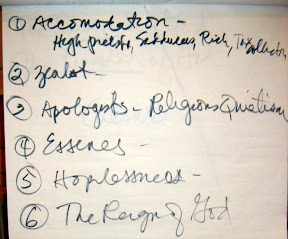
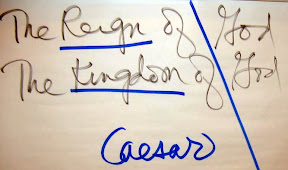
Jesus was setting up the same contrast between Caesar and Christ. It is not surprising that Jesus was put to death. If you try to save your life you will lose it, if you lose your life you will save it. Jesus recognized that those who named the evil of Rome would be in harm's way. Those who wrote the Gospels experienced this.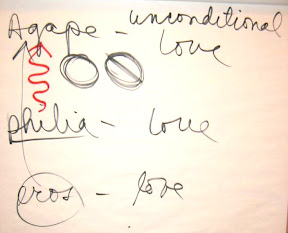
posted by Ryan @ 1/24/2007 10:45:00 AM
0 comments


0 Comments:
Post a Comment
<< Home