Jack Jezreel 1
Introduction of Jack Jezreel Eric first heard Jack 4 years ago at a Catholic Church in Boulder. Jack has been a presenter at the Externally Focused Summits Jack started an organization called Just Faith in Louisville, KY begun in 1989 Jack's Introduction I don't presume to have the authority to speak to a variety of traditions of which I have little background. I will say what I have to say in the hope that it will be helpful to you. I think that Eric has invited me to speak provocatively. Most of us grow through disorientation. Theirs not much growth at the country club. It's easy. Most growth in my experience raising kids and working with people in crisis, comes through challenge and struggle that I would not have chosen. AS my faith has grown, I am more willing to seek out experiences that will stretch me beyond what I have known before. I have gone with my oldest daughter to Haiti, the poorest country in the Western Hemisphere, and seen crisis and darkness. How do you integrate this kind of experience with your theology. Sometimes our theology is too glib to deal with this reality. I am Roman Catholic. My graduate degree is from Notre Dame. Catholics ask if I'm a Catholic because I have a Bible in my hand. My undergraduate degree was at Furman which is a Southern Baptist Institution. For six years I worked in Colorado Springs in a Catholic Worker community with mentally disabled adults. Many of those present were Mennonite. I'm constantly critiquing my own Catholic tradition to the lens of what I believe is the truth of the biblical testimony. I wish to speak prophetically but as I speak to you I am speaking to myself. As I challenge you I challenge myself. My wife who is Catholic comes out of a Southern Baptist background. She had some experiences that led her to work with those on the margins. At that time there was no outlet for that kind of ministry in the Southern Baptist tradition. When churches are looking past themselves they find immediate collaboration, fellowship and partnership. I used to be a farmer for ten years. I have an appreciation for how to take care of land. Two years ago I was diagnosed with stage 3 colon cancer. Two weeks ago I had a check up and everything was clean. I was 48 years old with young daughters. I was shocked and stunned by the news that I might not live another two years. For the first time I wrestled with the prospect of death. I went through disorientation of leaving my family. I thought if my end is near what should I do. I should do the things I haven't done that I want to do. I thought of Hawaii. I thought about a new car. I finally came back to, I'm just going to keep doing what I do. My work is trying to draw people into an appreciation of their faith that connects them to human crisis locally and globally. My experience with the poor or mentally disabled and with developing countries, drawing people into this work is the best kind of work for me to do. What we are about here is the stuff of abundant life. Not just life after death but eternal life, here and now, so richly lived that it intersects with the here and now. Quality of life in the here and now is a part of abundant life and eternal life. It means richness of life through giving myself away. Of course I must speak of this, to not share this life of faith would be stingy. I oversee a 30 week spiritual formation process in 40 states across the country. My work is done with Catholic Charities, Catholic Relief Services and Catholic Campaign for Human Development. These 3 Catholic organizations have helped just faith. Their have been Protestants who have begun to want to work with Just Faith as well. Some are more interested in potlucks and basketball than human sufferings. How do you provide an experience that draws people into a mini transformation that opens them to suffering. Jesus spent most of his time in this endeavor. The Parable of the Church. In the Catholic Tradition we talk about "Social Ministry" as a "constitutive" dimension of our mission. It's not sideline, it's primary, it's core. But saying so doesn't make it so. Imagine a Christian Church that doesn't have "worship". What makes it a church? We have a picnic or bingo? If that's awkward, to imagine a church that doesn't meet for worship, it should be just as awkward to say that we are a church without ministry to human suffering. If your church doesn't work with the poor, then what makes it a church. We are drawn here by a doctrinal statements and tradition and intuition. We know we should be externally focused intuitively. There are normal and appropriate moments of self focus, but the life of a Christian is naturally outwardly focused. We call it a body because it has work to do and places to go. If in fact the social mission is constitutive then it must be found in the person and work of Jesus. In the course of these three days your going to hear much about Jesus and less about Paul. Starting Place I start with the tradition that births Jesus. All of Jesus' heroes, prayer forms, holidays, theological categories come from Jews. Jesus was a Jew mostly talking to Jews about what it meant to be Jewish. The earliest church includes those who are Jewish who even after Jesus died and rose still called themselves Jews. We are as Christians a branch of the tree of Judaism. When the early church was trying to decide on the canon there was debate about the Hebrew Scriptures. It was decisively included because it is impossible to understand Jesus apart from the Hebrew Scriptures. This allows me to introduce some key concepts. When we look at the heart of Judaism (Jesus was a devout Jew) the covenant is the heart. The law is the covenant and Jesus came to fulfill it. There is clearly an affection by Jesus for the Covenant. What is the Covenant? I'm going to speak to the pieces of the covenant that are critical to our purpose for gathering. I'm going to start with the critical narrative of the Covenant. I'm not a scripture scholar but I am taking what I have learned from scholars on the scripture and the covenant. This is my effort at drawing together these kinds of commentary. The critical narrative of the covenant is the encounter between God and Moses. Exodus 1:11-14 11 So they appointed taskmasters over them to afflict them with hard labor. And they built for Pharaoh storage cities, Pithom and Raamses. 12 But the more they afflicted them, the more they multiplied and the more they spread out, so that they were in dread of the sons of Israel. 13 The Egyptians compelled the sons of Israel to labor rigorously; 14 and they made their lives bitter with hard labor in mortar and bricks and at all kinds of labor in the field, all their labors which they rigorously imposed on them. The Hebrews experienced the cruel fate of slaves. Let me read a passage more prayerfully. The whole cruel fate of slaves. Today we don't use the word slaves, we talk about "Human Trafficking" where in 40 Thousand children are missing. Human slavery is always terrible always abominable. This is apparently the prompt for God to get involved in history. Not their race but their suffering moves God to get directly involved. Moses and Jesus are compared to one another. Liberation With that as context here is what God does not say to Moses, "I've heard the cries of my people, I want you to tell them it gets better in the hereafter." Nor is it (Catholic Version) "tell them to offer it up". God says, "I want you to set them free from their bonds". This first piece of Covenant narrative Is a kind of liberation. It's bigger than freeing people from physical chain. It is bigger than that, but in includes that. The outside matters. Liberation from Egypt. Egypt is guilty of sin that is so vast that we're tempted to think of it as utterly evil. Walter Brueggeman is trusted by Catholic and Protestant institutions. Brueggemen makes this observation. What does God object to in Egypt: Three offensive realities in Egypt. They are coextensive: After Moses has freed the people from this trinity of evil he establishes his covenant (law). The Covenant is the terms of the relationship. What's the stuff of Fidelity that is the terms of the covenant. The Covenant is the blueprint for how Israel is the opposite of Egypt. You are called to be HOLY HOLY HOLY (Different). The covenant is a building block for a posture of anti-slaver, anti-poverty, inclusive. Climax: For the Good Jew (Jesus) the stuff of faith is necessarily religious, political, and economic. God takes this stuff very seriously.
From GLC Jan 07 
We have received a grant to make our materials available to the larger church. This is made possible by Bread for the World, a Christian Hunger lobby that involves Just Faith and many others.
The word church does not occur in this story, but you will see the parallel.
On a dangerous seacoast where shipwrecks often occurred their was once a crude little lifesaving station. The building was just a hut with one boat. The fearless and devoted members watched the sea day and night and tirlessly searched for the lost. Many were saved by this station and it became famous. Some of those who were saved and some from the surrounding area wanted to give if their time and money in support of this work. New boats were bought and the crew was trained. The work if the station grew. Some members of the life saving station were unhappy that the building was so crude and so poorly equipped. They felt that a more comfortable place should be provided for the first refuge of those who had been saved from the sea. So they replaced the cots with beds, bought better furnishing and invested in the lifeboats and enlarged the building to make it more capable and elaborate. Now the lifesaving station became a popular gathering place for it's members. They were proud of it. They redecorated it beautifully and furnished it exquisitely because it came to function as a kind of club. As it turned out, fewer members remained interested in going on life saving missions. It was dangerous. So they hired lifeboat crews to do this work.
Now the lifesaving motif still prevailed in the club decorations and there was a liturgical lifeboat on the wall in the room where club initiations were held.
About this time a large ship was wrecked just off the coast and the hired crew brought in boat loads of dirty and cold wet half drowned people. They were sick and had different colored skin and needed help. The beautiful new club was left untidy and muddy. The property committee immediately had a shower house built outside the club where the victims of shipwreck could be cleaned up before coming inside. At the next club meeting there was a split in the membership. Most of the members wanted to stopped the clubs activities of lifesaving as being somewhat beneath them and a unpleasant hindrance to the normal social life of the club. Other members insisted that they were a known as a life saving station and that saving lives was the primary purpose. They were finally voted down and told that if they wanted to save all the various kinds of people with different skin and language and religion that were shipwrecked on those waters they could start their own lifesaving station down the coast. And so they did.
As the years went by the same changes that occurred in the old club happened in the new life saving station. And then yet another life saving station was founded. The history continued to repeat itself.
If you visit that coast today you will find many exclusive clubs along that shore. Shipwrecks are still frequent in those waters but today most of those people drown.
Any human institution, movement or organization that start with generosity, sacrifice, courage and passion is somehow lost over time.
What separates charity and justice is that charity is addressing the symptoms, justice addresses the root causes.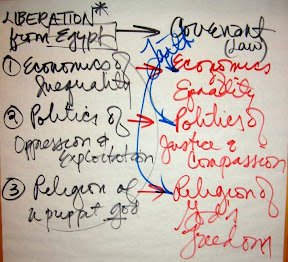
This system becomes impervious to critique. KY has more farmers than any other state. More of the population are involved in agriculture as an percentage than any other state. Historically the largest land owners in KY were the brothers of the county judge, or the mayor, or the preacher or the priest. This was a closed system, especially to people of color. This is the good old boy club. If you're not in the club, you do not have access. This means change is not possible. 
Numbers, every household of Israel receives land. Human dignity is related to land and access to land. You may not sell you land or buy another's. If you sold your land, your kids are at risk of slavery which looks like Egypt. Deuteronomy 15:4 4 There will, however, be no one in need among you, because the LORD is sure to bless you in the land that the LORD your God is giving you as a possession to occupy. At the root, everyone gets access.
Sabbath: God rests, everyone rests. The Sabbath is in part a response to slavery. Never again will anyone be allowed to work like a slave. That is not God's intention. It is easy for ministers to act like slaves working 7 days.
Sabbatical Year: a year of rest, debt forgiveness. Debt means desperation. Leviticus shows that the neighbors need is more pressing than the impact of the loan. Economics in Israel is not of competition.
Jubilee: all of the sabbatical ordinances times two. All land is returned. No second generation poverty. Servants and Slaves are freed to go back to the home farm. Forgive us our debts is grounded in a jubilee context. Sin is linked with economics. If I keep what's yours it's sin.
What is the content of the covenant in the Scriptures that Jesus knew: Justice
Right relationships. This is connected to Shalom. Shalom only happens in the context of Justice. All relationships are connected. When I read the newspaper the pleasure of my life is diminished.
As religious people we make arguments that use language that everyone can understand.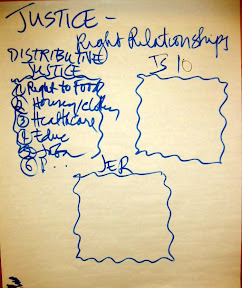
If I have what I need (rights), I have a responsibility to share.
Woe to those who make laws that ignore the poor. The Jewish assumption is that the state has a great deal at stake at the expression of the vision. The state has an autobiography: the laws it passes. Laws tell you who is valued, what is valued. Government should be Good, not small or big.
MLK: I look forward to the day Black and White men embrace.
When we take this into the Acts story, they become transformed.
Compassion addressed the hurts immediately. There is no perfect system so there are always immediate hurts that demand compassion.
Voltaire: God's image
God is not trapped in any culture or race. In the Jewish tradition the non-institutional peasant farmer might say something more authoritative than the King: Prophets. Prophets usually speak on behalf of the marginalized against the powers that be, the king.
From GLC Jan 07
Catholicism is a top heavy tradition but sometimes a little woman can speak more authoritatively than the most big hatted bishop.
posted by Ryan @ 1/23/2007 11:06:00 AM
0 comments


0 Comments:
Post a Comment
<< Home